Products
Upgrade any Oracle DB to the latest version
ORMIT™DB™: The only automated Oracle Database upgrade tool supporting all Oracle DB versions
Save up to 75% on upgrades costs. Eliminates the guess work of manual upgrades. Remain supported
and secure.
* Results may vary, contact us for a more in-depth evaluation.
The ORMIT™ DB advantage
-
75%
SIGNIFICANT COST SAVINGS
ORMIT-DB delivers an automated migration or upgrade with 50% to 75% less time than any manual upgrade.
-
100%
SIMPLIFIED, GARANTEED PROCESS
RENAPS ORMIT™ DB eliminates all upgrade risks associated with a manual migration or upgrade
-
60+
TAILORED SUPPORT & GUIDANCE
RENAPS' Center of Excellence is comprise of 60+ individuals with industry experience and Oracle® expertise. They will guide you through the migration process from setup to the final delivery
Why ORMIT™-DB ?
Migrating to Oracle 19c multitenant is not just a wise choice; it's a strategic imperative. It serves as a mandatory prerequisite for any future upgrades to higher Oracle database releases, such as the latest long-term release Oracle 23ai. This makes it an essential stepping stone for staying current and ensuring your database remains supported and secure.
– Shawn Craven (Partner Architecture & Infrastructure Management , RENAPS)
Why upgrade your Oracle Database to 19c multitenant and higher?
Database Consolidation
Multitenant architecture allows you to consolidate multiple databases into a single container database (CDB), reducing infrastructure costs and complexity.
Resource Isolation
It provides the ability to isolate resources, ensuring consistent performance for different applications or departments within your organization.
Simplified Management
Managing multiple pluggable databases (PDBs) within a single CDB simplifies administrative tasks, from backup and recovery to patching and upgrades.
Efficient Cloning
PDBs can be quickly cloned, making it easier to provision new databases and create development and testing environments.
License Flexibility
The licensing change in Oracle 19c allows for up to three user-defined PDBs in a CDB without additional licensing, offering cost advantages for organizations with moderate PDB requirements.
Enhanced Security
PDBs provide logical separation of data, enhancing security and isolation.
Scalability
The multitenant architecture is highly scalable, allowing you to add more PDBs as your organization's database needs grow.
Industry-leading performance
Oracle Database 19c provides customers with industry-leading performance, reliability and security for both transactional and analytic workloads
Automatic query quarantine
Unlike with previous Oracle versions, 19C solves the problem of overloading system resources with query requests. This version provides automatic query quarantine to ensure that specific queries aren't running over and over.
ORMIT™ is cost effective
50%–75% savings
ManualAutomated
- Setup
- Analysis
- Plan
- Migration
- Pre-deployment Tasks
- Testing
- UAT
Want to see ORMIT™ DB in action ?
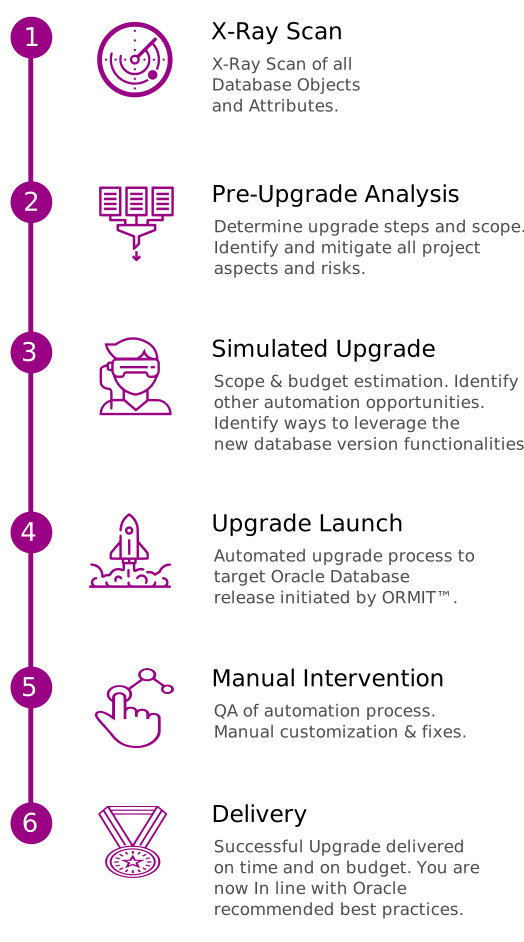
The ORMIT™-DB Upgrade Process
ORMIT™-DB automates the upgrade from earlier versions of the Oracle Database to the latest versions.
ORMIT™-DB guarantees the overall success of your Oracle Database upgrade with an emphasis on efficiency, cost and time savings, eliminating any potential risk. The automated process is extremely fast and secure. It automates a large quantity of actions while eliminating the guess work associated with manual upgrades. ORMIT™-DB also minimizes downtime and identifies manual tasks that require DBA action.
Oracle Database Upgrade with ORMIT-DB FAQ
What is the minimum Oracle Database version required to perform a direct upgrade to Oracle 19c using ORMIT-DB?
To upgrade directly to Oracle Database 19c, your source database should be running one of the following minimum versions:
- Oracle 11.2.0.4
- Oracle 12.1.0.2
- Oracle 12.2.0.1
- Oracle 18c
In the ORMIT-DB automated upgrade procedure, it is customary to apply the latest terminal patch provided by Oracle to all ORACLE_HOMEs in your source database.
When utilizing ORMIT-DB, what are the benefits and considerations considered when opting for out-of-place upgrades over in-place upgrades when migrating to Oracle 19c?
Out-of-Place Upgrade:
Benefits:
- Reduced downtime: You can run the new database in parallel, minimizing downtime.
- Testing: You can thoroughly test the upgrade without affecting the existing database.
- Backout plan: Easier to revert to the previous version if issues arise.
- Incorporate and execute widely accepted industry best practices within the target system.
- An opportune time to perform an operating system upgrade on the target system.
Considerations:
- Requires additional hardware and storage.
- May require changes to application connection strings.
In-Place Upgrade:
Benefits:
- No need for additional hardware.
Considerations:
- Minimal testing opportunities.
- Longer downtime.
- Less flexibility to revert to the previous version.
- Increased complexity resulting from prior installations or configurations that did not adhere to best practices.
- Cannot upgrade and convert to multitennancy.
What are some of the most demanding post-upgrade tasks that ORMIT-DB considers after upgrading to Oracle Database 19c?
The most challenging post-upgrade tasks typically include:
- Verifying data integrity and object counts.
- Ensuring compliance with licensed options.
- Migrating deprecated features like DBMS_JOBS to DBMS_SCHEDULER_JOBS.
- Ensuring user password hashes are in at least 12c format.
- Rectifying any invalid objects.
- Optimizing database statistics and performance.
- Testing application compatibility.
- Updating backup and recovery strategies.
- Performance tuning.
- Documenting changes.
Is it possible for ORMIT-DB to upgrade and convert a non-multitenant database into a 19c multitenant database?
Yes, you can convert and upgrade a non-multitenant (non-CDB) database to a multitenant (CDB) architecture in Oracle Database 19c. This process involves creating a new pluggable database (PDB) in a CDB and migrating your data into it. The steps include creating a CDB, plugging in a PDB, and migrating data into the PDB. All automated steps are performed following Oracle® recommended best practices.
Should I anticipate improved performance in a 19c database that has undergone an ORMIT-DB upgrade and utilizes the multitenant architecture?
The performance impact of the multitenant architecture in Oracle Database 19c depends on various factors, including your specific use case, database design, and resource allocation. Some considerations ORMIT-DB takes into account:
- Resource Sharing: Multitenant architecture allows for better resource sharing, as multiple pluggable databases (PDBs) share a common container database (CDB). This can be more efficient in terms of resource utilization.
- Isolation: PDBs are isolated, and resource management can be controlled at both the CDB and PDB levels. This isolation can prevent resource contention among different applications or tenants, potentially improving performance.
- Consolidation: Multitenant architecture is particularly beneficial for database consolidation. It allows multiple applications or tenants to coexist within a single CDB, which can lead to more efficient resource usage and reduced hardware costs.
- Simplified Management: Centralized management of PDBs simplifies tasks such as backup, recovery, and patching. This can save administrative time and improve database management efficiency.
- Pluggable Database Performance: The performance of each PDB can vary based on its workload, configuration, and resource allocation. You have the flexibility to allocate resources according to the specific needs of each PDB.
- Testing and Tuning: The migration to a multitenant architecture may require careful testing and tuning to achieve optimal performance. Factors like shared resources, CPU, memory, and I/O must be managed effectively.
Oracle Database 19c's multitenant architecture holds the promise of enhanced performance by streamlining resource utilization and administration. Nevertheless, the actual performance enhancements are contingent upon the particulars of your implementation, the workload, and the optimization endeavors. ORMIT-DB thoughtfully considers all these factors. Conducting thorough pre-migration performance analysis, meticulous planning, as well as ongoing monitoring and tuning, are vital to fully realize the performance advantages offered by the multitenant architecture.
Oracle DB Upgrade: Meet the complete Automated ORMIT™ Migration Suite
ORMIT™ Analyzer
Migration effort planning & analysis tool
ORMIT™ Open Java
Oracle Forms to Angular or React migrationORMIT™ DB
Automated Oracle Database Upgrade
ORMIT™ APEX
Oracle APEX to Java migration
ORMIT™ Forms
Automated Oracle Forms upgrade
ORMIT™-Jasper
Oracle Reports to JasperReports migration
ORMIT™ Cortex
Oracle Database to PostgreSQL migration
ORMIT™ AP
Oracle Reports to Analytics Publisher migration
Why Renaps?
With more than 20 years of experience, RENAPS has positioned itself as a trusted partner of many high profile brands. Our unparalleled knowledge of the ins and outs of Oracle products make us the ideal partner to help you make the most of your Oracle systems.